What Your Car Battery Is Worth as Scrap
8 min read · August 17, 2026 · Updated August 29, 2026
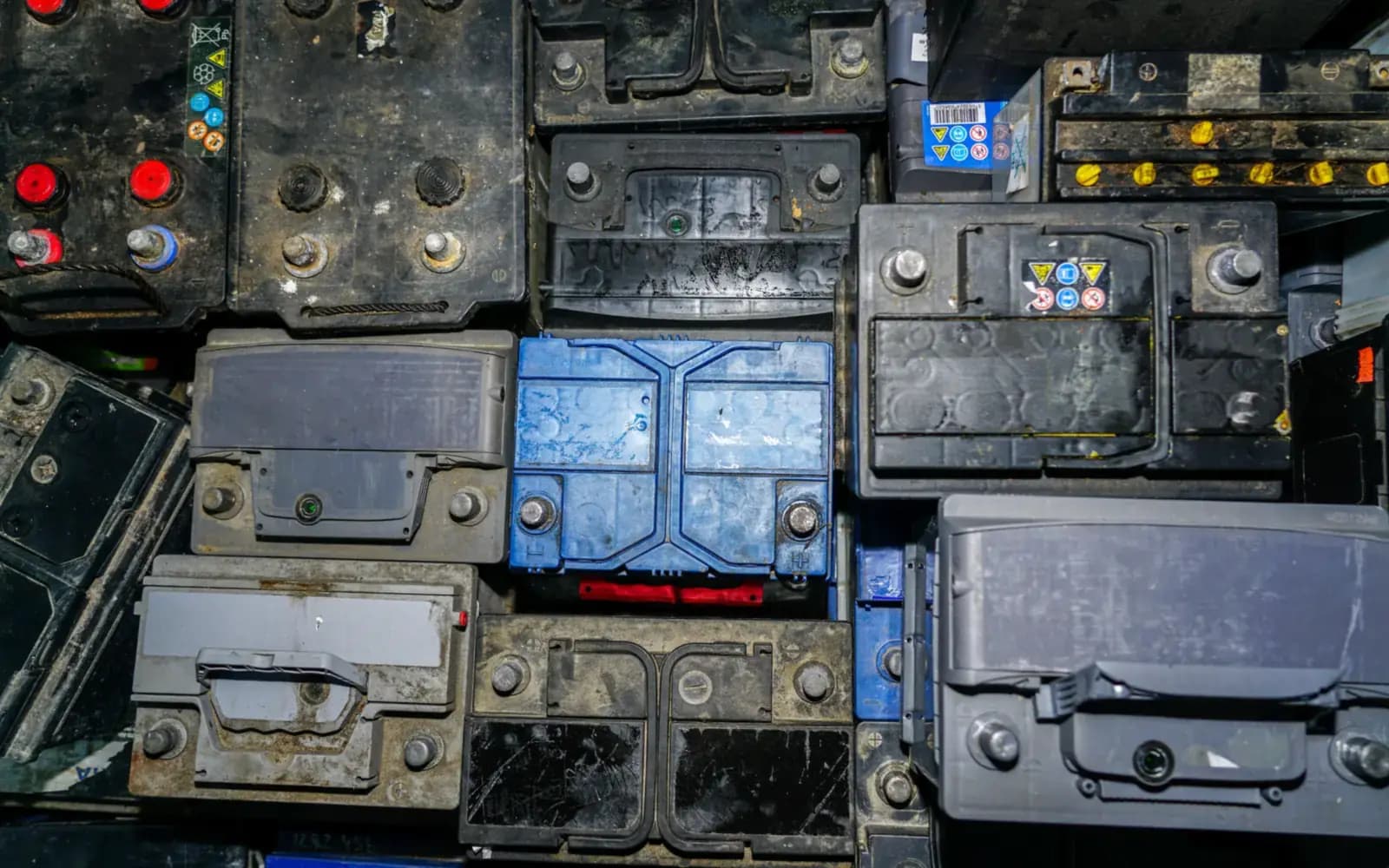
A lead-acid car battery has real scrap value because the lead inside it is one of the most efficiently recyclable materials in the industrial economy — the EPA reports that lead-acid batteries are the most recycled product in the United States. What that battery is actually worth at any given moment moves with the scrap lead market and varies by buyer, so we won't quote you a number here. What we can tell you is exactly why it holds value and what New York law requires when you hand one over.
Why is a car battery worth anything as scrap?
A standard automotive battery is a lead-acid battery: a plastic case holding lead plates and lead oxide paste, submerged in a sulfuric acid electrolyte. Lead is dense, valuable as a commodity metal, and — critically — it can be smelted down and reused in new batteries almost indefinitely without losing quality. That combination is rare. Most recycled materials degrade a little with each reprocessing cycle; battery lead largely doesn't. According to the EPA's case study on the lead-acid battery collection network, newly manufactured lead-acid batteries in the U.S. already contain more than 80 percent recycled material, which tells you how tight and effective this particular recycling loop already is.
The plastic case matters too, though less than the lead. Battery casings are typically polypropylene, which is also recyclable and gets separated out during processing rather than landfilled alongside the lead and acid. The acid itself is neutralized or, in some processing streams, converted into other usable compounds rather than simply discarded.
Why are lead-acid batteries recycled so well compared to almost everything else?
The same EPA case study puts a number on it: lead-acid batteries are recycled at a rate of about 99 percent, making them, by the EPA's own description, the most recycled consumer product in the country — ahead of aluminum cans, cardboard, and glass. That's not an accident of consumer goodwill. It's the result of three things working together.
First, state-level disposal bans make it illegal in most states, New York included, to simply throw a lead-acid battery in the trash, which removes landfilling as a legal option and pushes every battery toward a collection point. Second, a financial incentive — a "core charge," typically in the range of $5 to $20 depending on the retailer — is built into the purchase of a new battery and refunded when an old one is returned, which gives consumers a direct reason to bring the old battery back rather than let it sit in a garage. Third, the collection and recycling network itself is industry-funded and genuinely dense: retailers, core recyclers, and battery manufacturers all have a financial stake in the loop closing, which is a very different setup from, say, curbside plastic recycling, where nobody downstream is paying anyone upstream to participate.
What does New York law actually require?
New York's Lead-Acid Battery Recycling Law, in effect since 1991, is enforced through the state Department of Environmental Conservation. It requires any retailer or distributor that sells lead-acid batteries to accept used ones back from customers, free of charge — and that obligation isn't limited to a one-for-one swap. Under DEC's published guidance, a consumer can return up to two used batteries per month to a retailer even without buying a new one.
If you buy a new battery and don't hand over your old one at the time of purchase, the retailer is required to charge you a $5 "NYS Return Incentive Payment," itemized separately on your receipt. Bring the old battery back within 30 days of that purchase, and the retailer is required to refund the $5. Retailers that sell online are also required to notify customers that trash disposal is illegal. If a battery does get thrown out rather than returned, DEC's guidance states that illegal disposal carries a civil penalty of up to $50 per violation. Retailers are legally required to post signage stating, in DEC's own wording, that state law requires them to accept vehicle batteries free of charge for recycling.
None of this is a suggestion or a courtesy program — it's state law, built specifically around the fact that lead-acid batteries are hazardous waste if mishandled and valuable commodities if handled correctly. That dual identity is exactly why the rules are strict rather than optional. Lead is toxic to soil and groundwater in a way that most household materials aren't, and a cracked battery case left outdoors or thrown in with regular trash risks leaching both lead and sulfuric acid into the ground long after anyone's paying attention to it. A battery return system with a financial incentive attached solves that problem far more reliably than a voluntary program ever could, which is a large part of why New York — like most states — chose to legislate it directly rather than leave it to goodwill.
Why does the value fluctuate so much?
Scrap lead is a globally traded commodity, priced off the same underlying market forces as other base metals: industrial demand, mining output, and the balance between newly mined "primary" lead and recycled "secondary" lead entering the market. Because more than 80 percent of the lead in a new U.S. battery is already recycled material, the battery industry is unusually dependent on a steady stream of scrap coming back in — which means recyclers' willingness to pay for a used battery tracks fairly closely with how tight or loose that supply is at any given moment. A stretch of high demand or a supply disruption elsewhere in the market can move the price a scrap buyer offers within weeks, sometimes days. That volatility is normal for a commodity-backed material and isn't specific to batteries — the same pattern shows up in scrap steel and aluminum pricing, which is part of what determines a junk car's overall offer as well.
What actually happens to the battery once it's turned in?
A battery accepted by a retailer or scrap buyer typically moves to a permitted recycler, where it's broken down mechanically: the case is cracked open, the lead plates and paste are separated from the plastic casing, and the acid is drained and processed separately. The lead components go to a smelter, where they're melted and refined back into usable lead for new batteries or other lead products. The polypropylene casing is cleaned, shredded, and reprocessed into new plastic. None of the three major components — lead, plastic, acid — is designed to be wasted in a properly run recycling stream, which is a big part of why the battery has scrap value in the first place: there's a genuine buyer for every piece of it.
Does a dead car battery affect what a junk car buyer offers?
It can factor in, but not the way people often expect. A battery that's present and in reasonably normal condition is a small, incremental piece of a much larger offer built around the car's overall weight, working parts, and condition — our guide on whether a working engine, newer battery, or good tires raise the price covers how those individual pieces do or don't move a total number. A missing battery generally isn't a dealbreaker either; it's simply accounted for. Hybrid and EV batteries are a different animal entirely — they're high-voltage lithium-ion packs, not lead-acid, and they come with their own handling requirements and value questions, which is exactly why we cover them separately in selling a hybrid or EV with a dead battery in NY rather than folding them into this page.
Why we're not quoting you a scrap price
Scrap lead prices move with global commodity markets, sometimes meaningfully within a single week, and a specific dollar figure published today would likely be wrong by the time you read this. Beyond that, what a given buyer pays for a battery depends on its size, condition, and their own arrangement with a downstream recycler, which varies buyer to buyer. Anyone publishing a fixed "your battery is worth $X" number online is either guessing or quoting a moment in time that's already passed. If you want to know what a specific battery is worth today, the honest answer is to ask a scrap buyer or battery retailer directly rather than trust a number sitting in an article.
What this looks like for a seller in New York
Picture someone in Broome County whose fifteen-year-old sedan finally won't turn over. The battery tests dead. Under New York's return rules, if they bought a replacement anywhere in the state, the retailer is required to take the old one back for free, and if the seller doesn't hand it over at purchase, they're on the hook for the $5 incentive payment unless they return it within 30 days. None of that changes if the whole car — battery included — instead goes to a junk buyer rather than to a battery retailer separately; the value of the lead inside doesn't disappear either way, it just gets accounted for as part of the larger vehicle sale instead of a standalone battery return.
Where CashMyCarNY fits in
We buy junk cars across all 62 New York counties, battery included, running or not. A free instant offer takes about a minute, and if the number works, we schedule free towing — often the same day when it's arranged by early afternoon. If you're weighing whether it's worth separating out individual parts like the battery versus selling the whole car, our page on junkyard vs. scrap yard vs. dismantler explains who's actually set up to buy what.
Quick answers
Why does a car battery have scrap value? It contains lead, a commodity metal that can be smelted and reused almost indefinitely without losing quality. The EPA reports that lead-acid batteries are the most recycled consumer product in the U.S., which is a direct result of how efficiently that lead gets recovered and reused.
How much is my car battery worth as scrap? We're not going to guess. Scrap lead prices move with global commodity markets and can shift week to week, and value also depends on the battery's size, condition, and the buyer's own arrangement with a recycler. Ask a scrap buyer or retailer directly for a current number.
Does New York require stores to take back my old battery? Yes. Under New York's Lead-Acid Battery Recycling Law, any retailer that sells lead-acid batteries must accept used ones for free, and consumers can return up to two batteries a month even without a new purchase, per DEC's published guidance.
What is the $5 core charge or return incentive payment? If you buy a new lead-acid battery in New York and don't turn in your old one at the same time, the retailer must charge a $5 "NYS Return Incentive Payment," itemized on your receipt. Return the old battery within 30 days and the retailer must refund it.
Is it illegal to throw a car battery in the trash in New York? Yes. DEC's guidance states that illegal disposal of a lead-acid battery carries a civil penalty of up to $50 per violation, which is part of why the return system exists in the first place.
Does a dead battery hurt my junk car offer near Broome County? Not meaningfully. A missing or dead battery is a small factor in a larger offer built around the car's weight and condition, and that holds true statewide, including in Broome County.
Get your instant offer
Free towing · No hidden fees · No obligation
Frequently Asked
Will you buy a car that failed NY inspection?
Yes. A failed inspection is one of the most common reasons people call us — and the repair estimate is often worth more than the car. We buy it whether it passed or not.
What kinds of cars do you buy?
Just about anything — running or not, wrecked, flooded, rusted out, or missing parts. We make offers on cars that other buyers pass on.
Do I need the title?
Having the title in hand is best — you'll sign it over in the seller section on the back at pickup. If your title is missing, tell us your situation and we'll walk you through what's possible.
How is my offer calculated?
We price your car based on year, make, model, and condition, plus current scrap value that week. Newer and larger vehicles are generally worth more, but there is no typical figure worth quoting — the number depends on your specific car, so get your own instant offer for the real one.
Is towing really free?
Yes — free towing means $0, no hidden fee, anywhere in New York.
How fast can you pick up?
We move quickly once your offer is accepted. Exact timing depends on your location and schedule, so we'll confirm a pickup window with you directly.
What paperwork do I need in NY?
You'll need your signed-over title, and your plates should come off before pickup. New York requires sellers to surrender plates to the DMV before canceling insurance, and the DMV issues an FS-6 receipt for the surrender — we'll walk you through it.
What happens to my plates?
Remove your plates before we arrive for pickup. You'll then surrender them to the DMV and keep the FS-6 receipt as your proof of surrender — check dmv.ny.gov for details on the process.
When and how do I get paid?
You get paid at pickup once the vehicle and paperwork are confirmed — no waiting around for a check in the mail.
We’ll Buy It.
Because when it comes down to it, junk cars are our thing. Anywhere in New York.