Yes, you can register a salvage title in New York, but not as-is — the car has to pass a DMV salvage examination and come out the other side with a rebuilt title first. Registration follows that title change; it doesn't happen alongside it or instead of it. The process runs through DMV's Title Services Bureau rather than a regular registration counter, and it involves a specific paperwork package: the salvage certificate or title, an odometer and damage disclosure, a salvage examination application, and a payment DMV lists at $205.
This post covers the registration side specifically — what DMV requires before a salvage-branded car can carry plates again. For the mechanics of the examination itself, the fees DMV won't confirm, and the backlog that's affected wait times, our guide to the NY rebuilt-title exam is the deeper dive — this post picks up from there and focuses on what happens once you're trying to get the car back on the road.
Can you register a salvage title in NY?
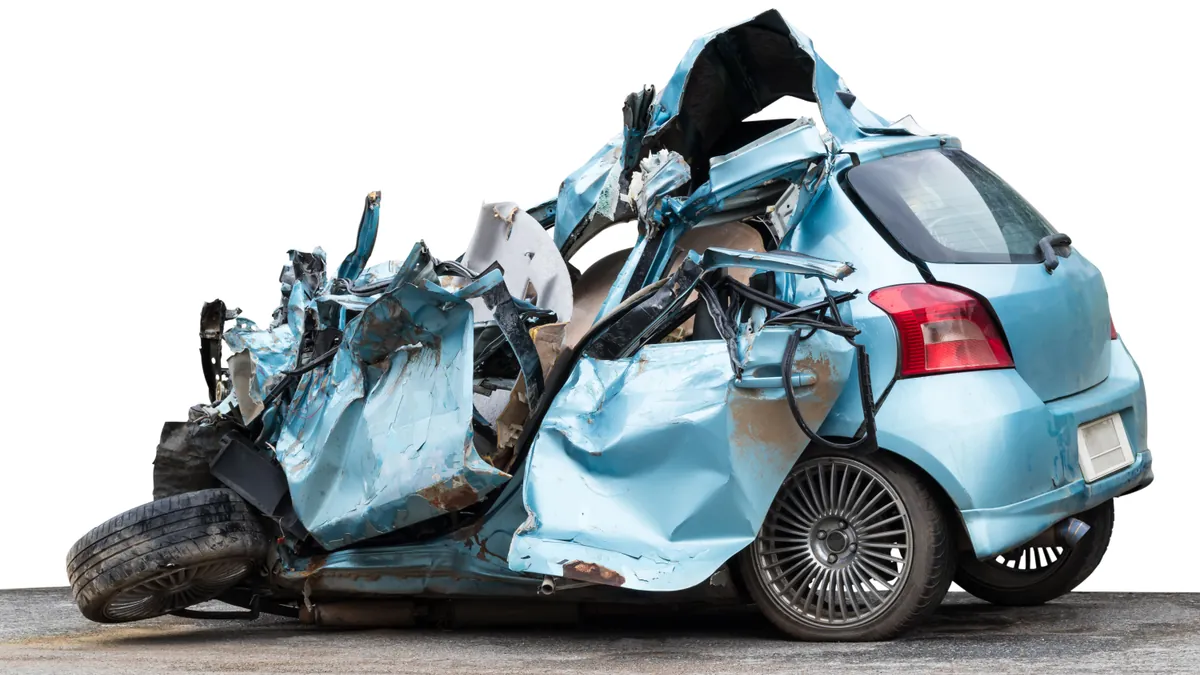
Not directly. A Salvage Certificate (MV-907A) isn't a registration-ready document — DMV's buying-a-salvage-vehicle page states that when the MV-907A "is the proof of ownership," applicants "must complete the salvage vehicle examination process in order to get a title." Registration only becomes possible once that exam produces a new title, and DMV's salvage vehicles page is equally direct on the ownership side of this: the department "will not examine or issue a new title certificate or vehicle registration for a rebuilt salvage vehicle that does not have a title certificate or Salvage Certificate (MV-907A) that proves ownership." In plain terms: no ownership document, no exam, no registration — the salvage certificate is the entry ticket to the process, not a shortcut around it.
This is a question that comes up most often after an insurance settlement, a private purchase where the seller was upfront about the brand, or a car pulled out of storage where the paperwork finally gets a close read. In every version of that story, the underlying question is the same: is there a legitimate way to get plates on this car again, or is the salvage brand a permanent dead end? The short answer is that it's not a dead end, but it's also not a quick registration counter transaction — it runs through a specific bureau with its own package of forms.
What does the salvage brand actually mean for the car?
DMV brands a title as salvage when a vehicle "8 model years old or newer" has been "destroyed or received damage of 75% or more of the retail value," according to the buying-a-salvage-vehicle page. That threshold is about repair cost measured against value, not visible damage — which is also why two cars with similar-looking damage can land in very different places depending on what they were worth beforehand. If you're not sure whether your car actually carries this brand or how it got there, our MV-907A guide covers the triggers in more detail, and our brand-decoder post walks through how salvage compares with the other NY title brands you might be looking at.
What paperwork does DMV actually require to register it?
Once the salvage examination path applies, DMV's buying-a-salvage-vehicle page lays out the package a new title — and eventually registration — runs on:
- The title certificate (or the properly proven Salvage Certificate) and proof that sales tax has been paid, brought to a DMV office first.
- A sales tax receipt, Form FS-6T, generated at that office visit.
- The Odometer and Damage Disclosure Statement (Form MV-103), mailed with the rest of the package to DMV's Title Services Bureau.
- The Salvage Examination/Title Application (Form MV-83SAL).
- A personal check for $205, payable to "Commissioner of Motor Vehicles," per the same DMV page.
That package goes to the Title Services Bureau, not a standard registration window, and DMV's page lists a direct line for that office — 1-518-486-4714, Monday through Friday, 8:30 AM to 4:00 PM — for questions about where a specific application stands.
Notice how much of that package is about proving two separate things at once: that you legitimately own the car, and that the car's condition and mileage are accurately disclosed on paper before DMV puts a new title behind it. That's a heavier lift than a routine registration renewal, and it's worth gathering every piece before you make the office visit rather than discovering a missing form after you've already paid the sales tax and generated the FS-6T receipt.
What title do you actually get back?
If the vehicle is 8 model years old or newer and passes the examination, DMV issues a title that will "display 'REBUILT SALVAGE: NY,'" per the buying-a-salvage-vehicle page. That branding stays with the car permanently — it's not a temporary flag that clears after a set number of years or a clean inspection. Anyone buying the car later will see that brand on the title, which is worth knowing if resale value matters to your decision about whether to register the car at all versus selling it as-is. Once you're holding that title, registration follows the normal process from there.
What happens if you skip the exam and just register the car anyway?
DMV's salvage vehicles page addresses this directly, and it's worth taking seriously if you're weighing shortcuts: "if the DMV finds that a recently registered vehicle has a salvage history, the DMV will notify the customer that the vehicle must go through the salvage vehicle process. The DMV will not issue a New York State title or allow you to renew your vehicle registration until the vehicle is examined and the title is issued." In other words, getting a car registered once — through an oversight, a records gap, or a title that didn't disclose the history clearly — doesn't settle the question. If the salvage history surfaces later, the registration stops renewing until the exam happens anyway, which means skipping it doesn't actually save the step, just delays it to a worse moment.
There's also a disclosure penalty attached to this. The same DMV page states that failing to disclose damage can carry "a fine of up to $2,000, and any additional penalties according to the NYS Penal Law." That's a separate risk from the registration freeze, and it applies regardless of whether the undisclosed history gets caught right away or years later.
Does the car's age change anything?
The 8-model-years-or-newer threshold in DMV's branding rule is specifically about when the 75%-damage trigger applies to force a salvage brand in the first place. Once a car is already carrying that brand, the guidance we've been able to confirm directly from DMV's own pages centers on the exam-then-registration sequence described above, regardless of how old the car is. If your specific car sits outside that 8-year window and you're unsure how the process differs for it, that's a case worth confirming directly with DMV's Title Services Bureau rather than assuming — this is one of the areas where car-specific details genuinely change the answer, and we'd rather point you to the source than guess.
Is the exam and registration process worth it?
That depends on math this post can't do for you, since it depends on your specific car's repair cost, its value with a rebuilt title attached, and how much the wait is worth to you — our exam-and-backlog guide goes through that comparison directly, including why DMV's Junk and Salvage Unit backlog has made timing harder to predict lately. What this post can tell you is the registration side specifically: there's no way to register a salvage-branded car for normal road use without going through that examination first, no matter how straightforward the rest of your paperwork is.
If you'd rather sell than register
Not every salvage-branded car is worth pushing through an exam, a $205 payment, and an uncertain wait — especially if the car's value even with a clean rebuilt title wouldn't cover what the process costs in time and money. Selling it as-is is a real alternative, and it sidesteps the registration question entirely, since a buyer who's dismantling the car isn't trying to put it back on the road. CashMyCarNY buys cars with salvage brands regularly — it's part of what a junk car buyer deals with day to day — and gives a no-haggle instant offer in about 60 seconds, with free towing anywhere in New York and payment at pickup, salvage certificate and all.
The short version
Registering a salvage title in NY happens on the far side of a DMV salvage examination, not instead of it — there's no direct path from a Salvage Certificate to plates. The paperwork package for that exam runs through DMV's Title Services Bureau: the title or salvage certificate, a sales tax receipt (FS-6T), the odometer and damage disclosure (MV-103), the salvage examination application (MV-83SAL), and a $205 payment. Pass the exam on a car 8 model years or newer, and the resulting title carries a permanent "REBUILT SALVAGE: NY" brand. Skip the exam and register anyway, and DMV can freeze the registration the moment the salvage history surfaces — plus a possible fine for non-disclosure. If the math doesn't favor the exam, selling the car as-is remains a straightforward option.
Quick answers
Can you register a salvage title in NY? Only after the car passes a DMV salvage examination and receives a rebuilt title. A Salvage Certificate (MV-907A) alone isn't a registration-ready document — it's the starting point for the exam process, not a substitute for it.
How do you get a salvage title cleared in NY? Through a DMV salvage examination that, if passed, replaces the salvage brand with a rebuilt title. Our exam and backlog guide covers that process and timeline in depth.
What does the salvage-to-rebuilt title paperwork package cost? DMV's buying-a-salvage-vehicle page lists a $205 personal check payable to the Commissioner of Motor Vehicles, alongside the MV-103 odometer/damage disclosure, the MV-83SAL application, and a sales tax receipt (FS-6T).
Can I register a salvage title car without the exam if I just don't mention the brand? No — and DMV's own page warns that if it later discovers undisclosed salvage history on a registered vehicle, it freezes new titles and registration renewals until the car goes through the exam, on top of a possible fine of up to $2,000 for non-disclosure.
Does a rebuilt title ever go back to being unbranded? No. Once DMV issues a title marked "REBUILT SALVAGE: NY," that brand stays with the car permanently and follows it through future sales.
Does this process work the same way for a car in Erie County as anywhere else in NY? Yes. The salvage examination and registration requirements are set by DMV statewide, so a car in Erie County follows the identical process as a car anywhere else in New York.
Get your instant offer
Free towing · No hidden fees · No obligation
Frequently Asked
Will you buy a car that failed NY inspection?
Yes. A failed inspection is one of the most common reasons people call us — and the repair estimate is often worth more than the car. We buy it whether it passed or not.
What kinds of cars do you buy?
Just about anything — running or not, wrecked, flooded, rusted out, or missing parts. We make offers on cars that other buyers pass on.
Do I need the title?
Having the title in hand is best — you'll sign it over in the seller section on the back at pickup. If your title is missing, tell us your situation and we'll walk you through what's possible.
How is my offer calculated?
We price your car based on year, make, model, and condition, plus current scrap value that week. Newer and larger vehicles are generally worth more, but there is no typical figure worth quoting — the number depends on your specific car, so get your own instant offer for the real one.
Is towing really free?
Yes — free towing means $0, no hidden fee, anywhere in New York.
How fast can you pick up?
We move quickly once your offer is accepted. Exact timing depends on your location and schedule, so we'll confirm a pickup window with you directly.
What paperwork do I need in NY?
You'll need your signed-over title, and your plates should come off before pickup. New York requires sellers to surrender plates to the DMV before canceling insurance, and the DMV issues an FS-6 receipt for the surrender — we'll walk you through it.
What happens to my plates?
Remove your plates before we arrive for pickup. You'll then surrender them to the DMV and keep the FS-6 receipt as your proof of surrender — check dmv.ny.gov for details on the process.
When and how do I get paid?
You get paid at pickup once the vehicle and paperwork are confirmed — no waiting around for a check in the mail.
We’ll Buy It.
Because when it comes down to it, junk cars are our thing. Anywhere in New York.