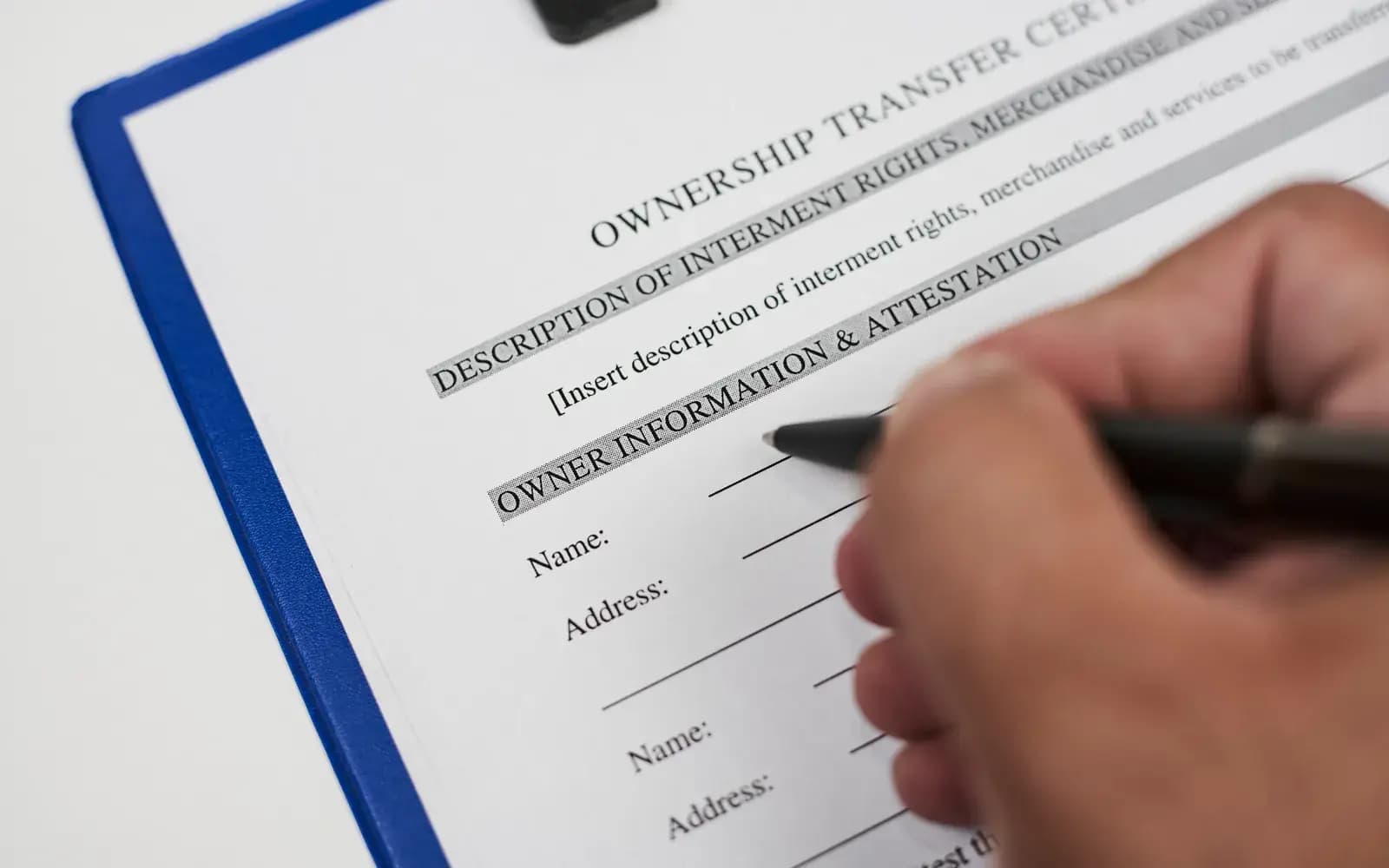
To transfer a car title in New York, the seller signs the transfer section on the back of the title and both the seller and buyer sign a Vehicle Bill of Sale (MV-912), even for a gift. The buyer then brings the signed title, the bill of sale, and proof of sales tax (or an exemption) to a DMV office to register and title the vehicle in their name. New York does not let you simply "change" an existing title into someone else's name — the DMV's own guidance is explicit that ownership is transferred, not edited.
That's the outline. The details below cover what goes where, what a family transfer or an added spouse changes, and what happens if the title isn't in a normal, sign-and-go condition.
What the seller has to do on the title

New York's title certificate has a transfer section on the back built for exactly this moment. According to DMV's Buy, Sell, or Transfer Vehicle Ownership page, the seller must either complete and sign that transfer section and sign a Vehicle Bill of Sale (MV-912) — even if the vehicle is a gift — or provide another acceptable proof of ownership and transfer.
Practically, that means:
- The buyer's full legal name and address go on the transfer section, exactly as it will appear on the new registration.
- The date of sale, matching the date on the bill of sale.
- The odometer reading, entered as a whole number for vehicles from the 2011 model year or newer that are 20 model years old or newer — DMV requires the Odometer Disclosure Statement on the back of the title for those vehicles specifically, per its acceptable proofs of ownership page.
- The Damage Disclosure Statement on the back of the title, which DMV says must be completed for every vehicle transfer regardless of the vehicle's age.
- The seller's signature, written to match the name already printed on the front of the title.
Our line-by-line walkthrough of filling out the NY title when you sell goes field by field if you want the order laid out in more detail.
Why you can't just "change" a title into a new name
DMV states this plainly on its transfer-ownership page: you cannot change the name on a vehicle registration or title certificate to the name of another person. You have to transfer ownership of the vehicle, using the process above, even between people who trust each other completely. There's no shortcut form for swapping a name in place — the title has to move through a real sale, gift, or transfer, with a signed transfer section and a bill of sale, every time.
That rule doesn't bend for family. A parent adding an adult child, a spouse being added to a title, or a sibling taking over a car that's been sitting in a driveway all go through the same transfer section and bill of sale as a sale to a stranger. What changes for family isn't the mechanics — it's the tax form.
What's different when you transfer a title to a family member or spouse in NY

New York's sales tax rules give a specific exemption to certain transfers between close relatives. On the Statement of Transaction (DTF-802), the seller or donor completes Section 6 whenever the vehicle is a gift, or is sold below fair market value, to someone other than a spouse, parent, child, stepparent, or stepchild. Read the other direction: DMV's language on the transfer page draws that same line around spouse, parent, child, stepparent, and stepchild as the relationships that qualify for different tax treatment.
The transfer section on the title and the bill of sale requirement don't go away for a family transfer or when you add a spouse to a title — the buyer still signs the MV-912 and the seller still signs the title's transfer section, per DMV's transfer-ownership guidance. What changes is the DTF-802: mark the vehicle as a gift or below-market sale if that's accurate, and complete Section 6 if the relationship and price qualify. Our guide to gifting vs. selling a car to family in NY breaks down the DTF-802 in more detail, including what "below fair market value" actually covers.
If you're not certain whether your specific relationship and price qualify for the exemption, confirm with the DMV or the Department of Taxation and Finance before you fill anything out — DMV's page states the categories but doesn't spell out every edge case, and guessing wrong on a tax form is a slower fix than asking first.
What if the title has two names on it?
If the title lists two owners, the safe assumption is that both signatures are needed on the transfer section. DMV's guidance doesn't spell out when a single signature is sufficient for a jointly-owned title, so don't assume "and" versus "or" without confirming. If a co-owner won't sign, our guide on when a co-owner or ex won't sign the title walks through the realistic options, from tracking down the signature to using legal tools like a divorce decree.
What the buyer needs to bring to finish the transfer
Signing the title and the bill of sale is the seller's part. The buyer's part happens at a DMV office, where they register and title the car in their own name. Based on DMV's Buy, Sell, or Transfer Vehicle Ownership and certificate of title pages, the paperwork a buyer typically gathers includes:
- The signed title, transfer section completed by the seller.
- The signed Vehicle Bill of Sale (MV-912), or a DTF-802 if the vehicle was a gift or sold below fair market value.
- A completed Vehicle Registration/Title Application (MV-82).
- Proof of identity.
- Payment for the registration, plate, and title certificate fees, plus sales tax or proof of an exemption.
DMV notes that title certificates aren't handed over the counter — they're mailed after the application is reviewed, so a buyer walks out with a temporary registration and the plates or permanent registration, with the title itself arriving separately by mail. If the certificate doesn't show up within 90 days, DMV directs owners to contact a DMV Contact Center.
Confirm the vehicle's proof of ownership is still usable
Not every title in someone's glovebox is still valid proof of ownership. DMV's acceptable proofs of ownership page spells out a rule worth checking before you start filling anything in: if a seller's own title was itself transferred to them by a prior owner, they can't reuse it to transfer to a new buyer. They have to apply for a title-only certificate in their own name first, then transfer that new title. It's an easy detail to miss on an older car that's changed hands more than once, and it's the kind of thing that turns a same-day signature into a multi-week detour if it's discovered after the fact.
The same page also flags that any information altered, erased, or changed on a title makes it unusable for a transfer — the current owner needs a duplicate first. That lines up with the cross-out rule above: once a title has a correction on it, the safe move is a fresh copy, not a workaround.
A cross-out or a swipe of correction fluid on the transfer section can get the whole title rejected at a DMV counter. If your title already has a mistake on it, don't try to write over it — see our guide on fixing a cross-out or wrong name on a NY title for the duplicate-title process instead.
If you don't have the title at all — it's lost, or it never made it to you — the transfer starts with getting a duplicate before anyone signs anything. Our guide to selling a car with a lost title in NY covers that replacement process.
What happens after the title is signed
Once the title's transfer section and the bill of sale are both signed, the seller isn't quite done. New York expects the plates to be surrendered separately — they belong to the registered owner, not the car — and the FS-6 receipt kept as proof the registration actually ended. Our plate surrender and title guide covers that step and the order that avoids an insurance-lapse penalty.
The buyer's side isn't finished either. DMV states that after ownership transfers, the new owner must register and title the vehicle at their local DMV office and pay sales tax or show proof of an exemption. The signed title and bill of sale get handed to DMV as part of that registration, along with the MV-82 Vehicle Registration/Title Application.
Selling instead of transferring to family?
If the "family member" you're transferring to is really just someone taking a car off your hands because it doesn't run anymore, a title transfer isn't your only option. Selling a non-running or high-mileage car directly skips the odometer and damage disclosure questions that come up on a transfer to a private buyer, since a licensed buyer handles the paperwork on their end. An instant offer takes about 60 seconds, and if the car matches your description, the price doesn't change at pickup. Towing is free anywhere in New York, and it's folded into the offer, never billed back to you separately.
Quick answers
How do you transfer a car title in NY? The seller signs the transfer section on the back of the title, both the seller and buyer sign a Vehicle Bill of Sale (MV-912), and the buyer brings both documents plus proof of sales tax or an exemption to a DMV office to register and title the vehicle.
Can you just change the name on a title instead of transferring it? No. DMV's guidance is explicit that you cannot change the name on a registration or title to someone else's name — ownership has to be transferred through the signed title and bill of sale process, even between family members.
Does transferring a title to a spouse or family member skip the bill of sale? No. The bill of sale (MV-912) is still required, even for a gift. What changes for a qualifying relationship — spouse, parent, child, stepparent, stepchild — is the DTF-802 tax form, where Section 6 covers gifts and below-market sales to people outside that list.
What if my co-owner won't sign the title? There's no confirmed shortcut around a required second signature. See our guide on co-owners or exes who won't sign for realistic paths forward.
Does the transfer process work differently in Nassau County than the rest of the state? No. The transfer section, the bill of sale, and the tax form are all state requirements, so they're identical whether you're in Nassau County or anywhere else in New York. What differs by location is where you drop off paperwork in person, not the forms themselves.
What if the title is lost and there's nothing to sign? Start with a duplicate title before attempting any transfer. Our guide to selling a car with a lost title in NY covers that process.
Get your instant offer
Free towing · No hidden fees · No obligation
Frequently Asked
Will you buy a car that failed NY inspection?
Yes. A failed inspection is one of the most common reasons people call us — and the repair estimate is often worth more than the car. We buy it whether it passed or not.
What kinds of cars do you buy?
Just about anything — running or not, wrecked, flooded, rusted out, or missing parts. We make offers on cars that other buyers pass on.
Do I need the title?
Having the title in hand is best — you'll sign it over in the seller section on the back at pickup. If your title is missing, tell us your situation and we'll walk you through what's possible.
How is my offer calculated?
We price your car based on year, make, model, and condition, plus current scrap value that week. Newer and larger vehicles are generally worth more, but there is no typical figure worth quoting — the number depends on your specific car, so get your own instant offer for the real one.
Is towing really free?
Yes — free towing means $0, no hidden fee, anywhere in New York.
How fast can you pick up?
We move quickly once your offer is accepted. Exact timing depends on your location and schedule, so we'll confirm a pickup window with you directly.
What paperwork do I need in NY?
You'll need your signed-over title, and your plates should come off before pickup. New York requires sellers to surrender plates to the DMV before canceling insurance, and the DMV issues an FS-6 receipt for the surrender — we'll walk you through it.
What happens to my plates?
Remove your plates before we arrive for pickup. You'll then surrender them to the DMV and keep the FS-6 receipt as your proof of surrender — check dmv.ny.gov for details on the process.
When and how do I get paid?
You get paid at pickup once the vehicle and paperwork are confirmed — no waiting around for a check in the mail.
We’ll Buy It.
Because when it comes down to it, junk cars are our thing. Anywhere in New York.